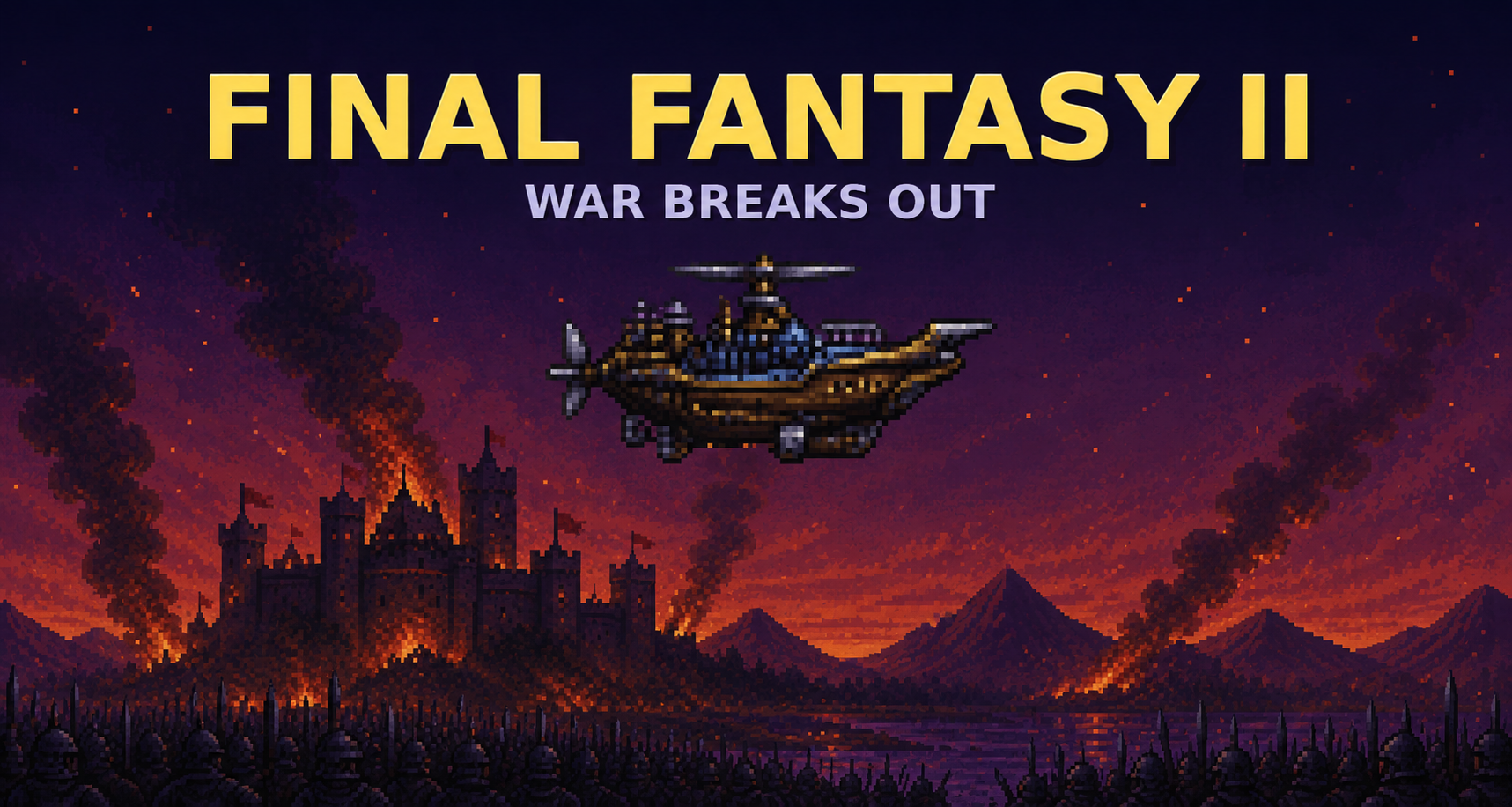
Quick reminder before we start: this series is spoiler-heavy by design, so if you’re planning to play FF2 clean, this is your out. I’m writing up the beats that actually landed for me and not a step-by-step walkthrough, which means I’m going to skip around and dwell on the stuff that stuck rather than march you through every dungeon. I closed the FF1 post by saying I’d heard FF2 was going to be a very different kind of experience, and yeah, that turned out to be an understatement.
A Very Different Final Fantasy
Right from the opening this is a far more cinematic game than FF1, and I mean immediately, because your village gets wiped off the map by the evil empire inside the first few minutes and your heroes, unlike the four anonymous warriors of light, actually have names this time, which sounds like a small thing but it quietly reframes the entire game. FF1 was four crystals and a world to fix. FF2 is a war. An actual war, with a resistance, an empire, towns getting bombed out of existence, and people you genuinely care about getting caught in the middle of it.
The structure leans hard into that, too. Instead of a steady clockwise march around the map you get a hub town in Altair that you keep coming back to, and that constant back-and-forth, returning to the same place to find it changed, makes the world feel like stuff is actually happening in it while you’re off somewhere else. You hire a flying machine that drifts around the map on its own when you’re not using it, you watch the empire roll out a flying battleship and start straight up bombing the hell out of towns, and you keep bumping into characters who are clearly being set up to matter later. It feels less like an adventure and more like a campaign, and I was on board almost immediately.
Leveling, or: Why I Kept Punching My Own Team
The game never explains its leveling system, but it becomes obvious fast that you level up based on what you actually do in battle, so swing a sword a lot and your sword skill climbs, take hits and your HP grows. It’s a great idea on paper, and it immediately leads to the dumbest possible behavior, which is me taking pot shots at my own damn party members to grind their stats, and look, there’s something very funny about a system that quietly encourages you to beat the hell out of your own friends to get stronger.
The flip side, and there’s always a flip side with this game, is that the system hides things from you. I was embarrassingly far into the playthrough, like genuinely late, before I realized you can level magic straight from the menu instead of only by casting it in combat, and I’d spent all that time hoarding spell uses for fights because I thought that was the only way to build them up. Once I figured that out a lot of the friction I’d been feeling around magic just evaporated. Better late than never, I guess.
The Keyword System Is Doing Real Work
The thing that surprised me most early on was the key terms system, where you learn a word from one NPC and then bring it up with another to unlock new dialogue and push the story forward. Branching, reactive conversation, on the NES, in 1988? That is not something I expected to find this early in the series, and frankly it’s wild how technically ambitious this game already feels. FF1’s NPCs were useful about ten percent of the time and generic flavor the rest. FF2’s NPCs are part of an actual web of information.
My one complaint, and it’s a real one, is that the game forgets about the system for long stretches. There’s a chunk in the middle where I was actively starting to think it had been abandoned, and then I get to Deist and suddenly it’s doing heavy lifting again. When it’s used well it’s one of the best things in the game. I just wish it had been used consistently instead of in these random bursts.
The Revolving Fourth Slot
Here’s the part that stuck with me most. Your three core heroes are constant, but that fourth slot is a revolving door of guest characters, and the game, to its enormous credit, is not the least bit shy about killing them.
Minwu shows up first and is immediately way too strong for the rest of my crew, so I pegged him as a temporary loaner from the jump, and then he leaves to keep the dying king propped up on magical life support, comes back much later, somehow beats me to the top of a tower I was actively climbing (still don’t know how he managed that), and then sacrifices himself. I’d spent the whole game low-key not trusting the guy, and then he goes and does that, and yeah, I felt like a complete jerk.
Then there’s Gordon, who I first met just hanging around like any other random NPC, and who turns out, surprise, to be the prince, which I did not see coming and which honestly says a lot about how casually this game introduces people who matter. Josef joins, helps out, and gets killed by Borghen, and that one landed way harder than I expected an NES death to land. Leila the pirate joins and I immediately started a private betting pool with myself over how she’d get written out. Even the dragoon, Ricard, is weak as shit when he joins and still doesn’t make it out the other side.
And here’s why all of it works, instead of just feeling like party-management churn: the deaths land on the world, not just the roster. Characters die, towns burn, the cost actually accumulates, and the whole thing builds toward the slow reveal with the Dark Knight, which is the payoff for all of it. Maria clocks his voice well before the game confirms anything, and when it finally lands that the Dark Knight is Leon, the missing fourth childhood friend, the whole thing clicks into place. A real character arc, with a real emotional turn, in a game this old. I did not expect to get this invested.
Dungeons, the Good and the Eight Doors of Hell
The dungeon design is all over the place, and I mean that as both a compliment and a complaint, because there’s genuinely no consistency to it.
On the good end, the masked-men dungeon down south was great, multiple paths, confusing in the fun way, no cheap nonsense, and I liked it enough that I didn’t even mind I’d wandered in before I was supposed to. On the bad end, there is a floor that is just eight identical doors where you pick the right one with zero information to go on, and the only punishment for guessing wrong is getting dumped into a small room that probably has a random encounter. That is, no exaggeration, some of the worst dungeon design I have ever seen. There’s no puzzle there. There’s nothing to read, nothing to deduce, it’s a coin flip wearing a dungeon costume, and it pissed me off every single time.
A lot of the back half is also just slog, plain and simple. The enemies stop changing across the last three dungeons, the empire’s keeps are stuffed with guards you can’t actually interact with, and I hit my first real under-leveled wall right around here. The turtles hit like a truck, and the Red Soul in particular had me convinced I was missing some trick, because it heals off magic and sits behind a wall of defense. The pacing whiplash is its own thing too: I did a whole dungeon, found the pendant I needed almost right away, kept going anyway like an idiot, and then had to backtrack the entire thing, and another time I fought all the way to the end of a dungeon only to realize I hadn’t actually rescued the princess, so back I went. The good dungeons here are some of the best in the early series. The bad ones are some of the worst. There is not a lot of middle ground.
The equipment pacing is its own special kind of weird, on top of all that. I was handed mythril gear early, which felt shocking given that the exact same tier was a late-game prize in FF1, and then near the end of the game I opened a chest and got, of all things, a basic knife. Throwing first-level loot at me in the final stretch is a choice.
Lost Again, the FF1 Way
I’d hoped the more guided, war-driven structure would cut down on the FF1 problem of having no real idea where to go next, and for the most part it does. And then there’s Mysidia.
Getting to Mysidia is a genuine pain in the ass. The game tells you to head south which, then as the dungeon under the castle, then as a staircase I’d missed, and it turns out, after all that, it actually means a town much further south that I had no clear way of finding. I caved, used a guide, and I still cannot tell you what the intended breadcrumb was supposed to be. There was an earlier moment too where I sailed to an island way down south just because the monsters there weren’t too tough, leaning on that old RPG instinct that easy enemies mean you’re roughly where you belong, and it turned out I’d misread “east” as “south” and wandered into content I wasn’t meant to see yet. That one was on me. Mysidia was on the game.
Setpieces Worth Showing Up For
For all the slog, FF2 has a real sense of spectacle that FF1 never once reached for. Taking down the empire’s flying battleship after watching it bomb towns felt like an actual military objective instead of a fetch quest, and the only sour note was getting back afterward to have that snooty old man tell me he “always believed I could do it,” as if he hadn’t cheerfully sent me off to die. I hate that NPC. I hate him in a way that an NES game has no business making me feel, and I mean that as a genuine compliment, because a game from 1988 reaching across nearly forty years to make me want to deck a pixelated old man is the storytelling working exactly as intended. The Leviathan is a highlight, mostly because the game has you fighting sea dragons inside the giant sea creature, which is exactly the flavor of absurd I am here for. I got way too excited finally seeing chocobos show up, stumbled into the Colosseum tucked off in a corner, and watched a cyclone tear villages apart in the back half.
And the run of late-game reveals is strong, stronger than I expected: the Dark Knight turn, the cyclone, and then the emperor coming back as an actual demon after you think you’ve already won. That’s a lot more narrative ambition than I expected from a game this old, even when the dungeons it’s all wrapped in are slowly wearing me down.
The little touches add up too. I’m pretty sure the temple theme here is the first appearance of that up-and-down melodic pattern that follows the series around for decades, the one I personally know best as the Final Fantasy Tactics continue screen, and hearing what might be its actual origin point was a real “oh, that’s where that comes from” moment. I also loved that you can read books in the world and feed what you learn back into the keyword system. And even Guy, who can apparently talk to beavers and speaks in full caveman saying things like “He guard mask”, is exactly the kind of weird character that makes this world stick in my head.
Wrapping the Second Crystal
The final dungeon is a long one, and honestly more of a snooze than I wanted given everything the game had built up to. I kept waiting for a fake-out, some twist where the emperor becomes a god or gets puppeted by something bigger, and instead it’s just a straight march to the end. The Dark Knight and demon-emperor reveals do a lot to redeem the finale, but the dungeon they’re stapled to is a grind. The game also crashed on me during the final cutscene, which was a heart-stopper right up until I remembered there was an autosave, and the final boss went down without much fuss on the second attempt anyway.
The ending earns its bittersweetness. Leon can’t come back with the group, and as much as I wanted that reunion, it makes sense for where his arc actually ended up. You kill the emperor a second time, the world gets to celebrate again, and the win feels paid for in a way that FF1’s victory never quite did.
I keep coming back to how much this game was clearly a prototype for ideas that show up later, because the activity-based leveling and the keyword systems are pure SaGa DNA, which tracks given Akitoshi Kawazu’s hand in both, and I kept catching flashes of SaGa Frontier in here, like an early sketch of something he’d spend a whole career refining. But what I love most, more than any single system, is that FF2 flat out refused to be another “a big crystal will save the world” story. It’s a war. People move in and out of the party, characters die, and those deaths ripple out past the roster and into the world itself.
The dungeon design held it back, and the navigation can still be obtuse in the worst FF1 ways, no question. But the ambition on display, the technical leap from the first game, and the fact that the characters actually have depth this time all add up to something that genuinely surprised me. Of my pre-FF6 games so far, this one is my favorite.
On to Final Fantasy III.